dBlank direct thermal labels provide a practical, ribbon-free option for short-term identification in shipping, inventory, warehouse, and distribution operations. A direct thermal printer creates an image by applying heat to a heat-sensitive label face stock. That makes these labels well suited to on-demand workflows where teams need to print variable information such as item IDs, handling instructions, location codes, or shipment details at the point of use.
The best choice is not simply a matter of label size. Teams should define how long the image must remain readable, what the label will contact, how it will be applied, and whether it must scan reliably throughout the intended workflow. Those details affect face stock, adhesive, roll configuration, and production planning.
How blank direct thermal labels work
Direct thermal labels carry a heat-sensitive coating. When the printhead applies controlled heat, the coating darkens and creates the printed image. Unlike thermal transfer printing, direct thermal printing does not use a ribbon.
This process can simplify routine printing for operations that create labels as orders move, inventory changes, or cartons enter a fulfillment flow. It is especially useful when the information changes from label to label and preprinted copy would create unnecessary inventory or version-control challenges.
However, heat sensitivity also shapes the application. Exposure to heat, sunlight, friction, moisture, or other environmental conditions can affect the image or the label’s performance. Buyers should treat the use environment as a core specification, not an afterthought.
Where blank direct thermal labels fit operational workflows
Blank direct thermal labels are commonly used where teams need fast, variable identification rather than a permanent branded label. Typical applications include:
- Shipping and parcel identification labels
- Carton, tote, and pallet identification
- Warehouse location and bin labels for short-duration use
- Pick, pack, staging, and routing labels
- Inventory movement and receiving labels
- Work-in-process identification
- Returns and temporary handling labels
In each case, the label needs to work with the printer, the application method, the surface, and the scanning process. A label that prints sharply but releases from corrugate or becomes unreadable before a handoff creates avoidable rework.
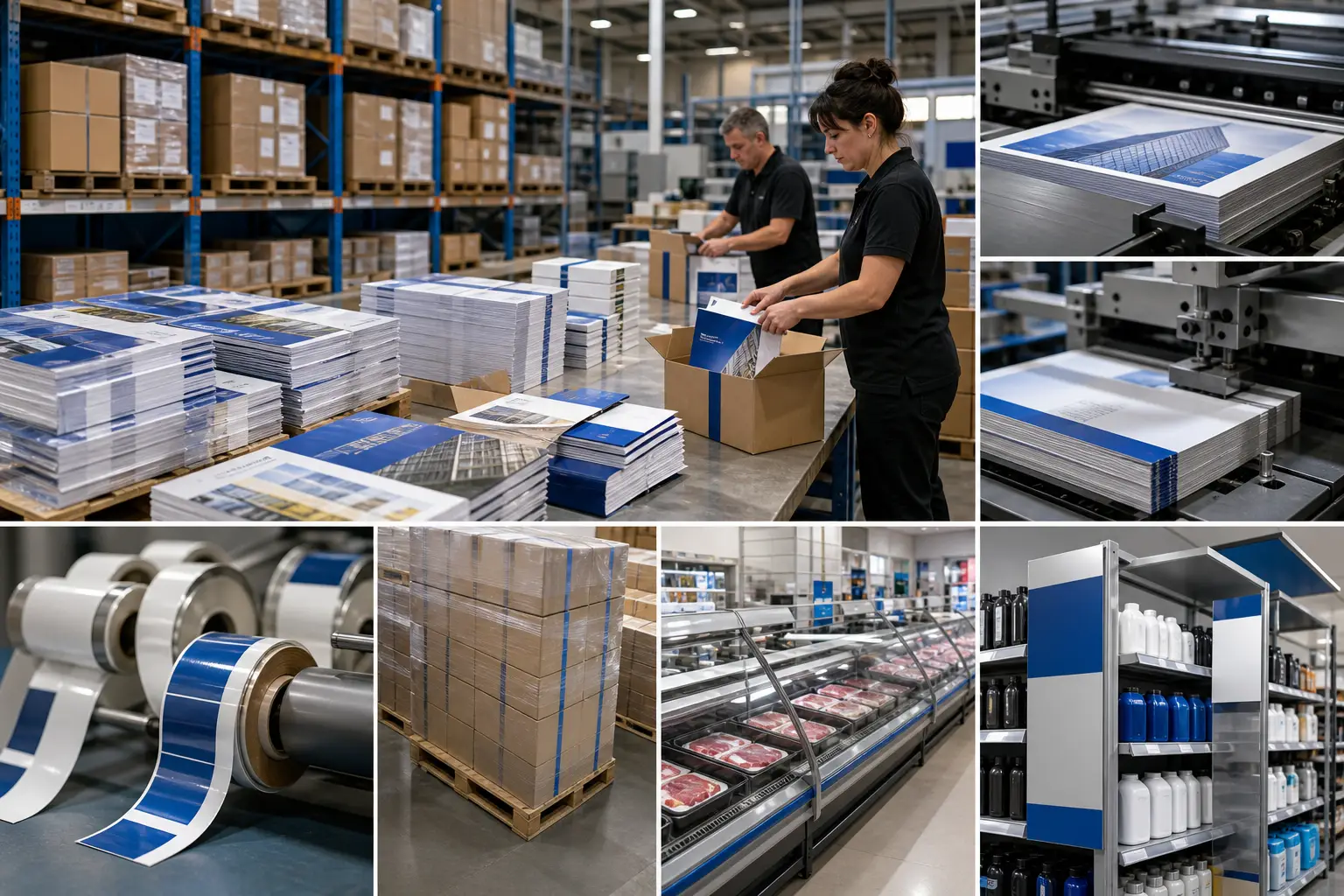
Distribution teams can also coordinate labels with cartons, documents, inserts, and store-specific materials. Print Group Inc. supports printing for distribution and wholesale operations, where accurate materials and organized execution support the movement of goods.
Specifying blank direct thermal labels: the decisions that matter
A clear specification helps prevent mismatched rolls, poor adhesion, and scanner issues. Start with the operational requirements below.
Label dimensions and usable print area
Select dimensions based on the information that must appear, the available application surface, and scanner placement. A label should provide enough space for variable data without crowding critical elements. If a barcode is part of the design, allow room around it so the code can be read without nearby text or edges interfering.
Also define whether the label needs a specific orientation. The direction in which labels feed through the printer matters, particularly when the print layout includes a barcode, serial number, or handling mark.
Face stock and image-life expectations
Direct thermal face stock should match the expected life of the label. Short-term shipping and internal movement can have different needs than products that sit in bright, warm, or high-contact areas. Describe the expected handling period and conditions to the production team before selecting a material.
Ask practical questions: Will labels be staged near dock doors? Will they be exposed to sunlight during delivery? Will workers handle the package repeatedly? Does the image need to remain readable through a return or receiving process? These answers guide material selection.
Adhesive and application surface
Adhesive performance depends on what the label contacts and the conditions at application. Corrugate, film, plastic totes, and other surfaces can behave differently. Temperature, dust, moisture, and surface texture also matter.
Specify the surface, the approximate application conditions, and whether the label must remain in place through transport or only within an internal process. Operations that involve refrigerated, frozen, or moisture-exposed conditions should evaluate a purpose-built alternative. Print Group Inc. offers cold storage and freezer labels for applications where standard label assumptions may not hold.
Roll configuration and printer compatibility
Roll labels must fit the printer and feed correctly. Confirm label width, core size, outside roll diameter, gap or mark requirements, and winding direction. Share the printer model and application method during quoting when possible.
These details are operational, not minor production notes. A correctly sized label on the wrong core or wound in the wrong direction can interrupt an otherwise routine labeling workflow.
Scan performance and variable data
When a label carries a barcode, test the intended printer, scanner, and data format together. Print darkness, barcode size, orientation, contrast, and placement all influence scan performance. Keep the label layout clear and avoid placing critical variable data where folds, seams, or edges may interfere.
For recurring programs, establish a controlled template and approval process. That reduces version drift between shifts, locations, and fulfillment partners.
Direct thermal versus thermal transfer labels
Direct thermal and thermal transfer labels serve different operational needs. Also, irect thermal labels create the image with heat on a coated face stock and do not require a ribbon. They can be a straightforward fit for short-term, on-demand identification.
Thermal transfer printing uses a ribbon to transfer an image to the label. It may be considered when the application calls for a more durable printed image or involves more demanding exposure. The right choice depends on the actual use case, rather than a general preference for one technology.
If a label must endure significant abrasion, prolonged outdoor exposure, challenging temperatures, chemicals, or long-term asset identification, review the application with a label specialist. Print Group Inc.’s industrial and manufacturing labels page outlines the broader considerations involved in demanding production environments.
How to plan a repeatable label program
High-volume label programs benefit from a documented specification. Record the label size, material, adhesive, roll configuration, winding direction, printer requirements, and approved artwork or variable-data template. Add simple receiving and storage instructions so locations handle rolls consistently.
For multi-location operations, manage inventory levels and reorder points against usage patterns. Centralized planning can help locations receive the same approved label construction and avoid substituting a similar-looking product that does not perform the same way.
When labels ship alongside other operational materials, coordinated packing and delivery can reduce administrative work at the destination. Print Group Inc. provides kitting and distribution services for programs that require organized assembly and delivery to multiple locations.
Questions to answer before requesting a quote
- What will the label identify, and how long must the image remain readable?
- What printer model will produce the label?
- What size, orientation, and roll configuration does the printer require?
- What surface will receive the label?
- What temperature, moisture, handling, and storage conditions will it encounter?
- Will the label include a barcode or other variable data?
- How many labels are needed per roll, per location, and per reorder cycle?
- Do multiple warehouses or distribution points need coordinated delivery?
Blank direct thermal labels work best when the label construction reflects the actual workflow. Print Group Inc. can review the production, material, quantity, and delivery requirements for recurring warehouse and distribution label programs. Request a quote with the available specifications to begin the conversation.