
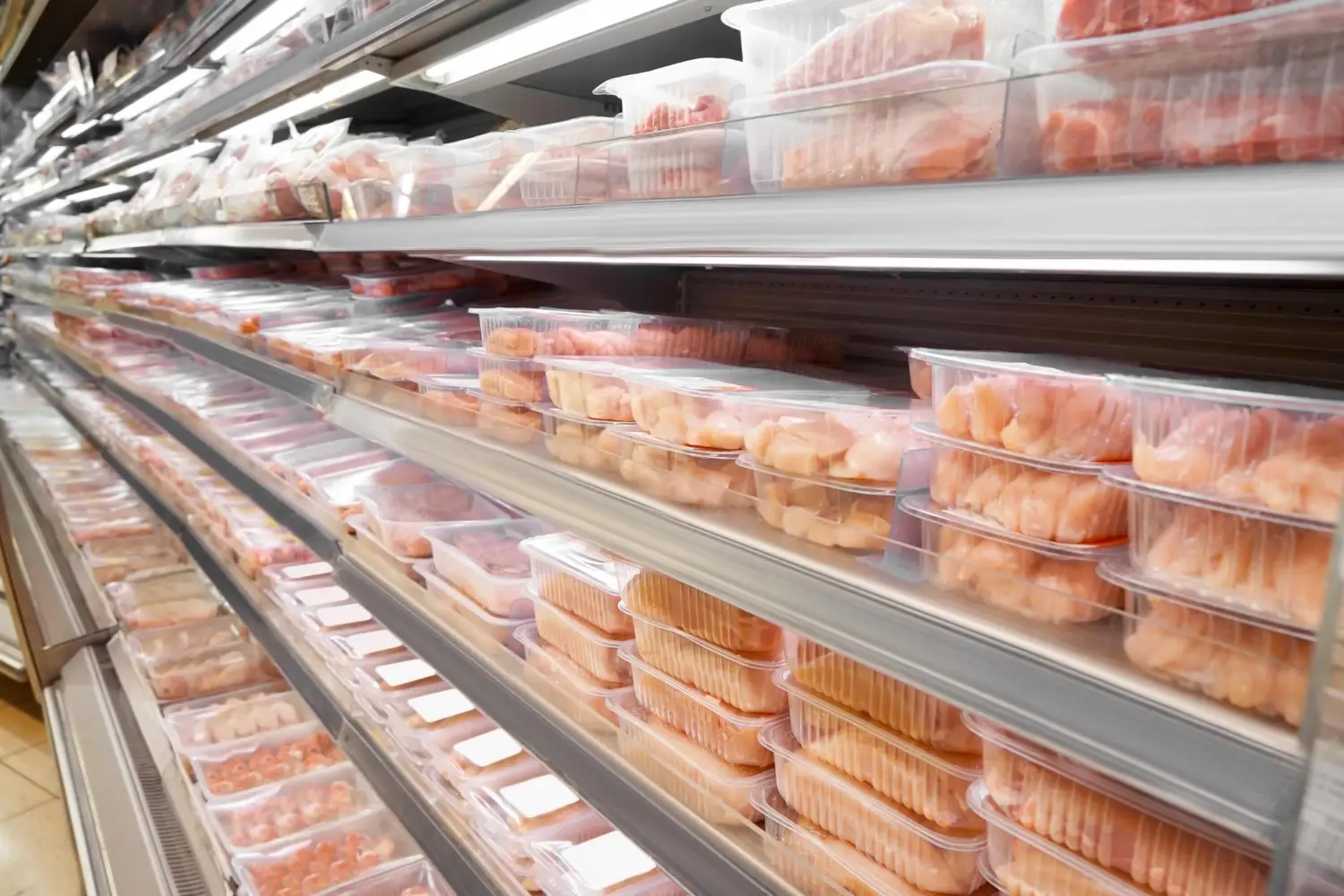
Engineered Adhesive Labels for Refrigerated, Frozen & Moisture-Exposed Environments
Cold environments are unforgiving—adhesives fail, edges curl, ink cracks, and labels peel during condensation.
In food processing, grocery distribution, and cold chain logistics, label failure is not cosmetic — it disrupts operations, compromises compliance, and damages brand trust.
Print Group Inc. provides engineered cold storage and freezer label printing services for grocery retailers, meat processors, food manufacturers, private label brands, and cold-chain distributors across the United States.
From refrigerated meat packaging to frozen goods, dairy containers, and warehouse identification systems, we produce cold-environment labels built for adhesion stability, moisture resistance, and long-term durability.
Based in Southwest Missouri and serving clients nationwide, our label engineering aligns with real-world cold storage performance requirements.
If your products live in refrigeration or freezing conditions, your labels must be designed for that environment — not adapted afterward.
Print Group inc.
Start Your Next Print Project
Tell us what you’re producing, and we’ll help you plan, price, and execute it with the consistency and scale your operation requires.

Why Cold Storage Labels Require Specialized Engineering
Standard adhesives are not designed for freezing temperatures.
Cold storage environments introduce:
- Sub-zero temperatures
- High humidity
- Rapid temperature shifts
- Surface condensation
- Frost accumulation
- Handling in wet conditions
When labels are applied incorrectly for these environments, common failures include:
- Adhesive breakdown
- Edge lift
- Curling corners
- Delamination
- Ink cracking
- Barcode scanning issues
Cold storage labels must be engineered with both adhesive chemistry and substrate compatibility in mind.
Why Cold Storage Labels Require Specialized Engineering
Refrigerated Food Packaging
Used for:
- Fresh meat packaging
- Poultry labeling
- Seafood containers
- Dairy products
- Prepared meals
Labels must:
- Adhere to plastic wrap and trays
- Withstand moisture from condensation
- Maintain nutritional panel clarity
- Preserve barcode readability
Moisture resistance is critical.
Frozen Food Packaging
Used for:
- Frozen meat
- Frozen vegetables
- Prepared frozen meals
- Ice cream containers
- Bakery goods
Frozen products require:
- Freezer-grade adhesives
- Substrates resistant to cracking
- Stable adhesion below freezing
- Ink systems that resist brittleness
Freezer conditions demand specialized adhesive formulation.
Cold Chain Distribution & Warehousing
Cold storage labels are also used for:
- Pallet identification
- Shipping cartons
- Warehouse tracking
- Inventory barcoding
Distribution labels must maintain adhesion even when:
- Applied in warm environments and stored cold
- Applied in cold environments directly
- Exposed to fluctuating temperatures
Application temperature is as important as storage temperature.
Finishing & Die Cutting
Label finishing options may include:
- Custom die shapes
- Gloss or matte coatings
- Protective laminations
- Specialty finishes
- Perforation
- Sequential numbering
Die precision ensures smooth application during packaging.
Regulatory & Compliance Considerations
Certain industries require strict label compliance, including:
- Food production
- Manufacturing
- Distribution
- Consumer goods
Compliance elements may include:
- Barcode readability
- Nutritional labeling alignment
- Allergen disclosure clarity
- Warning symbol placement
Production discipline protects regulatory integrity.
Integration with Packaging & Merchandising
Labels rarely exist in isolation.
They integrate with:
- Packaging components
- Shelf displays
- Retail merchandising systems
- Point-of-sale materials
Print Group’s integrated capabilities allow cohesive production across label, packaging, and in-store materials.
This supports brand alignment from warehouse to shelf.
Cold Storage & Freezer Labels Considerations
Adhesive Selection for Freezer Environments
Adhesive engineering is the core of cold storage labeling.
Considerations include:
- Initial tack performance
- Low-temperature bonding strength
- Moisture tolerance
- Surface compatibility
- Long-term adhesion stability
Freezer-grade adhesives are specifically formulated to:
- Bond in low temperatures
- Maintain flexibility
- Resist brittleness
- Prevent edge lift
Applying standard adhesives in freezer conditions leads to premature failure.
Proper engineering prevents operational disruption.
Substrate & Face Stock Considerations
Cold environments also impact face stock performance.
Materials must resist:
- Cracking
- Ink separation
- Surface moisture
- Physical handling in cold rooms
Substrate options may include:
- Moisture-resistant paper stocks
- Synthetic film materials
- Poly-based label materials
- Laminated protective surfaces
Material selection depends on:
- Product type
- Surface material
- Storage temperature
- Application method
Matching face stock to adhesive chemistry ensures long-term durability.
Printing & Ink Stability in Cold Conditions
Ink performance matters.
Cold environments can affect:
- Ink flexibility
- Color vibrancy
- Smudge resistance
- Barcode readability
High-quality flexographic or digital systems are calibrated to ensure:
- Strong ink adhesion
- Clean barcode contrast
- Consistent nutritional panel legibility
- Durable color reproduction
Label clarity must remain intact throughout storage and distribution.
Application Timing & Temperature Awareness
Cold storage labels must consider when the label is applied.
There are two common scenarios:
- Applied at Room Temperature, Stored Cold
Labels must withstand temperature drop and moisture condensation.
- Applied Directly in Cold Environments
Adhesives must bond in low temperatures immediately.
Improper adhesive selection for application timing leads to failure.
Engineering must align with operational workflow.
Compliance & Food Safety Considerations
Cold storage labels often contain:
- Nutritional information
- Allergen disclosures
- Lot tracking codes
- Expiration dates
- Regulatory markings
Failure to maintain legibility can create compliance risk.
Food labeling must remain readable throughout the product lifecycle.
Production discipline protects regulatory integrity.
Integration with Roll Labels & Flexographic Production
Cold storage labels are commonly produced as:
- Roll labels for automated packaging
- Custom die-cut formats
- Flexographic large-volume runs
- Digital short-run freezer labels
Because Print Group provides:
- Roll label production
- Flexographic printing
- Custom label engineering
We can align freezer labeling with packaging line requirements and production scale.
Centralized coordination improves performance consistency.
Quality Control & Testing
Cold storage label production includes:
- Application Environment Review
Storage and application conditions evaluated. - Adhesive Selection Engineering
Bond strength matched to temperature exposure. - Substrate & Ink Calibration
Materials selected for flexibility and durability. - Press Production
Flexographic or digital systems executed. - Adhesion Testing & Inspection
Performance verified before shipment.
Repeat production cycles maintain consistency across batches.
Industries That Depend on Cold Storage Labels
- Grocery Retail
- Meat Processing
- Poultry & Seafood
- Frozen Food Manufacturing
- Dairy Production
- Cold Chain Distribution
Cold environments require precision labeling.
Failure is expensive and avoidable with proper engineering.
Frequently Asked Questions
Can labels be applied directly in freezer environments?
Yes. Adhesives can be selected to bond at low temperatures.
Do labels withstand condensation?
Yes. Moisture-resistant materials and adhesives are engineered for that condition.
Are labels compatible with automated packaging lines?
Yes. Roll configuration is aligned with equipment specifications.
Do you serve national food processors?
Yes. We ship freezer-grade labels across the United States.
Request a Cold Storage & Freezer Label Quote
Print Group Inc. is structured to support your cold storage and freezer label production at scale.